I develop Bayesian forward modelling frameworks that employ the cosmic large-scale structure as a probe of the physics of the Dark Universe. My research focuses on the clustering of cosmological tracers in the dark matter density, peculiar velocity and tidal fields.
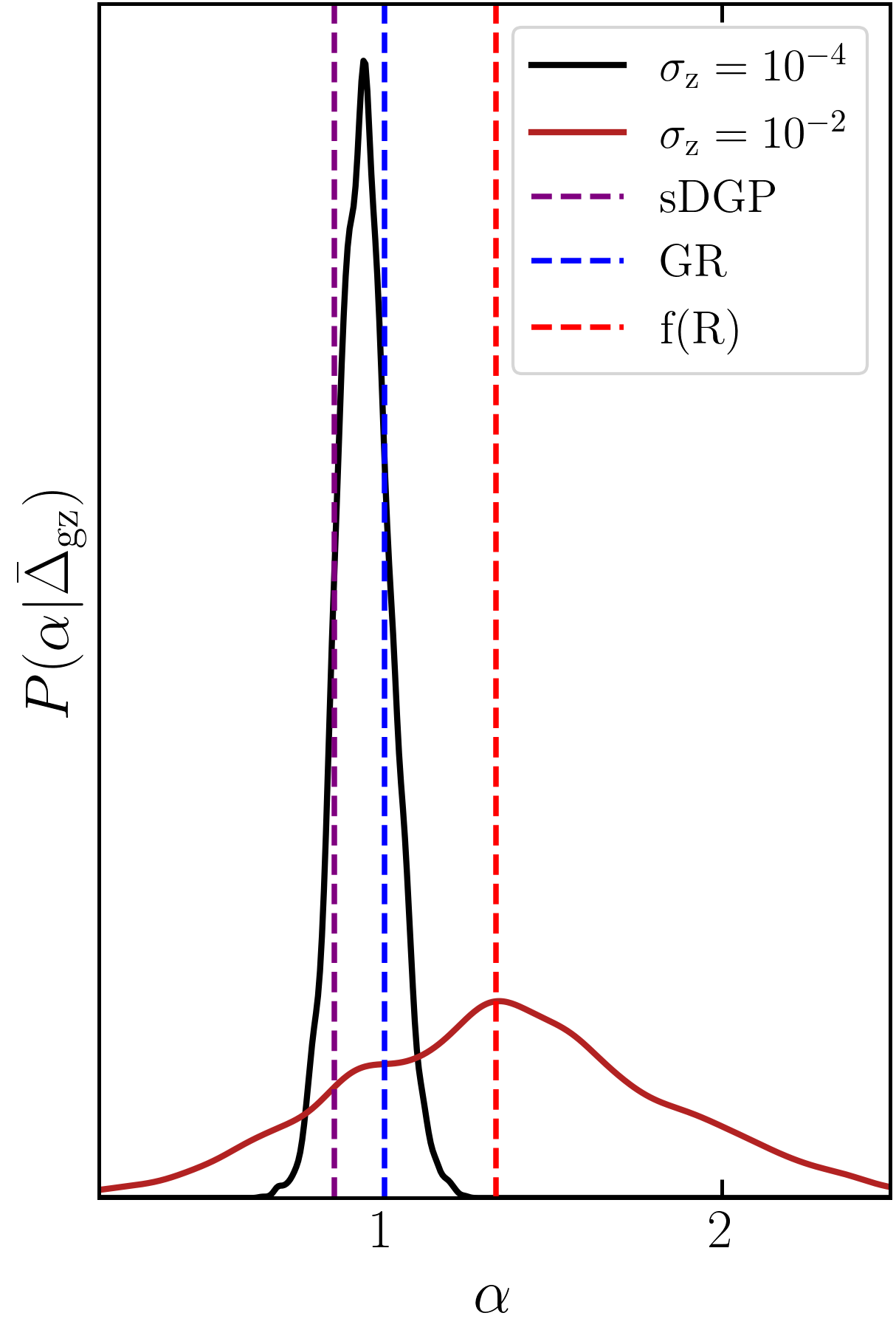
Persisting tensions in cosmological data and the unknown origin of cosmic acceleration make testing possible departures from general relativity one of the central questions in modern cosmology. In this work, we build an end-to-end pipeline to forecast the constraining power of gravitational redshifts of galaxies in clusters. We show that competitive measurements demand wide-field spectroscopic cluster surveys explicitly designed to maximise the number of spectroscopically confirmed members per cluster and to control systematic effects. In particular, efforts should prioritise mitigating offsets between the inferred and true cluster centres, which we identify as the dominant systematic for this probe.
Publication: arXiv
White paper: arXiv

One of the biggest puzzles in cosmology today is the Hubble tension — a mismatch in the measured expansion rate of the universe, called the Hubble constant (H₀), depending on how and where it is measured. It has been suggested that the motions of galaxies induced by gravity (peculiar velocities) in our cosmic neighbourhood may be biasing these measurements. In this study, we take a closer look at that idea. We simulate the positions of type Ia supernovae — cosmic mileposts used to measure distances — using simulated galaxy data following the clustering of real galaxies in the local Universe. We develop and validate a Bayesian Hierarchical Model which allows us to infer H₀ from SNeIa accounting for peculiar velocities self-consistently, while constraining the gravitational impact of the local Universe on the Hubble constant. We found that the effect of peculiar velocities is not sufficient to reconcile the Hubble tension alone. Our study paved the way for the use of SNeIa for inferences of the Hubble constant in the very nearby Universe.
Publication: MNRAS | Visualisation: YouTube | Data: Zenodo | Experiment: Google Colab

The Vera C. Rubin Observatory’s Legacy Survey of Space and Time will detect tens of thousands of supernovae per year, a detection rate which would in principle allow us to exploit supernova explosions to probe the environments of these transient phenomena to mitigate biases in cosmological inferences. In Tsaprazi et al. 2021a we studied the large-scale environments of supernovae follow the clustering of typical galaxies, despite their prevalence in star-forming environments. This study inspired the above investigation where we investigated the clustering of supernova in the peculiar velocity field. An exciting prospect lies in understanding its impact not only on measurements of the Hubble constant, but also the evidence for dynamical dark energy.
Vlog: YouTube

Next-generation photometric surveys will deliver redshifts with an uncertainty corresponding to as much as 300 Mpc or more. Reconstructing the large-scale structure from highly uncertain galaxy locations results in structures that are distorted. Here, we developed a method that mitigates such distortions, while also constraining individual galaxy redshift probability density functions. Our framework provides Markov Chain Monte Carlo realizations of the primordial and present-day large-scale structure as constrained by galaxy clustering, accounting for survey- and data-related uncertainties. Owing to the structure formation model we employ, we reconstruct the structure formation history of the large-scale structure, as well as filaments. We provide constraints on the large-scale structure on scales much smaller than the original redshift uncertainty.
Manuscript: arXiv

Galaxy shapes are not random, but align with the large-scale structure. This effect, known as galaxy intrinsic alignment, is linked to a multitude of cosmic phenomena. It provides constraints on galaxy formation and evolution, the initial conditions of the Universe, redshift-space distortions, as well as the gravitational wave background, among others. Constraints on intrinsic alignment further allow the decontamination of the weak lensing signal from intrinsic galaxy shape correlations which bias cosmological estimates. In Lamman et al. 2024, we created a guide to intrinsic alignment formalisms, models, estimators and useful references. My colleagues also prepared a presentation of the guide in Shaun Hotchkiss’ Cosmology Talks on YouTube.

Vlog: YouTube